

Most homeowners think leaks happen when it rains. In Texas, the opposite is true.
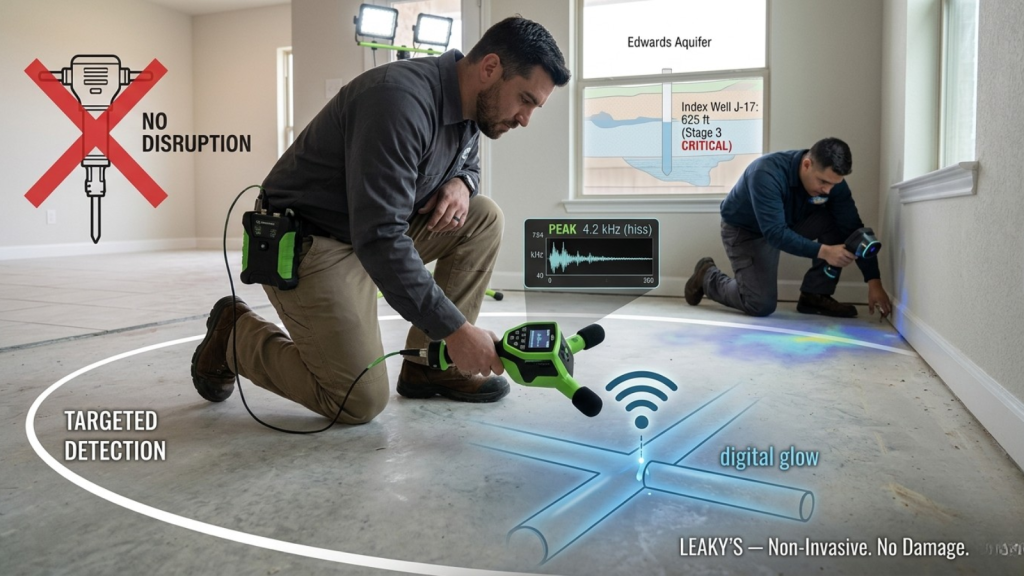
In San Antonio and Lubbock, the ground is being pulled underneath our feet. The latter of March 2026 marked stage 3 drought for San Antonio with the J-17 index well, the heart of the Edwards Aquifer, has dipped to critical 625.6 feet. This has been labelled as a situation of exceptional drought that comes with its own set of restrictions. Homeowners are facing 2 very expensive slab snap catastrophes.
The Science of the Soil:
The Texan soil is famously known for its “fat”clay and caliche soils. These soils act like a sponge, expanding and absorbing when it rains and shrinking when it’s dry. Today, the soil isn’t just dry, it’s seeing a multi-year moisture deficit. As the soil under your house loses its moisture support, it contracts, leaving a vacuum of air between the dirt and your concrete foundation.
This lets the heavy slab inevitably settle into those vacuum voids. However they do not move alone, the copper and PVC pipes buried within the concrete are subjected to the moving forces. This doesn’t just lead to leakages but snaps.
The Financial Leak:
For residents in San Antonio and Lubbock, a slab leak in 2026 is no longer just an unfortunate repair bill, but is a recurring financial penalty.
The 8% SAWS rate hike now firmly in effect and the Stage 3 Surcharge of $10.37 per 1,000 gallons looming for any usage exceeding the 20,000-gallon threshold, the margin for error has vanished. A single “pinhole” leak can push a standard household into a predatory billing bracket. A leak the size of a ballpoint pen tip can waste 10,000 gallons a month.Furthermore, under 2026 enforcement rules, if your ConnectH2O smart meter flags a 24-hour continuous flow, you could be hit with an automatic Non-Compliance Charge before a human inspector even reaches your door. In the current regulatory climate, that “silent” vibration under your floorboards could be costing you an extra $150 every month in surcharges alone.
Non-Invasive Detection: Finding the Needle Without the Haystack
The “old way” of finding a slab leak involved a jackhammer and a prayer. In the modern era of technological advancement, that’s a recipe for structural ruin. Modern “No-Damage” detection has turned plumbing into a forensic science.
Modern leak detection has changed the way we handle underground pipe problems. Instead of guessing where a leak is and digging up the floor, experts now use high-tech tools like “sonic” microphones and pressure tests. These tools allow them to find the exact spot of a leak through layers of concrete without any drilling or mess. It is a much cleaner approach that keeps the house quiet and the foundation strong.
When it comes to fixing the pipe, the repair is just as precise. Instead of a massive construction project that ruins your floors, technicians use targeted methods to fix only the broken area. This means you don’t have to worry about broken tiles or expensive reconstruction. By using this smart technology, a slab leak can be solved quickly and professionally, leaving your home exactly the way it was before, just with a perfectly working plumbing system.
At Leaky’s, we understand that your home is your most significant investment, and in the face of the 2026 Texas drought, you can’t afford to let a hidden slab leak undermine its foundation. Our non-invasive detection and repair technology ensures that your plumbing is restored with surgical precision: no jackhammers, no broken tiles, and zero disruption to your daily life. By catching “silent” leaks early, we help you bypass surcharges and protect the structural integrity of your property before the shifting soil causes permanent damage. Trust the experts who prioritize both your pipes and your peace of mind—whether you’re dealing with a slab leak in San Antonio or right here in Lubbock.
Don’t let a hidden leak drain your bank account.